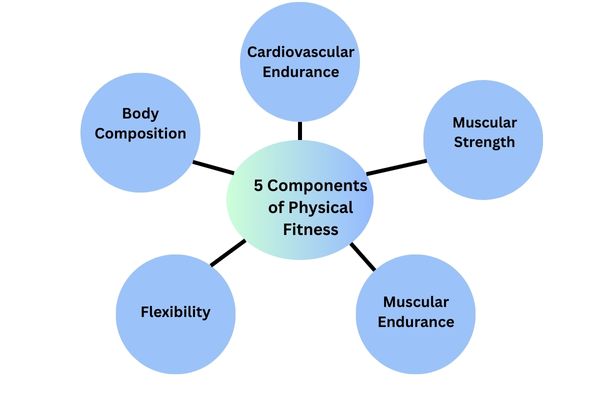

When most people hear the term physical fitness, they imagine six-pack abs, bulging biceps, or running a marathon. But true fitness is about much more than appearance or a single athletic skill. In reality, it’s built on the 5 components of fitness, a balanced combination of abilities that help your body perform at its best, whether you’re competing in sports, working on the job, or simply going about everyday life.
The Importance of All Five Components
The five components of physical fitness are all important because together they build a balanced, healthy, and resilient body. Focusing on all five cardiovascular endurance, muscular strength, muscular endurance, flexibility, and body composition ensures better performance, injury prevention, and long-term wellness.
Cardiovascular Endurance: Your Energy Engine
A strong heart and healthy lungs give you the stamina to keep going—whether you’re running, biking, or just keeping up with daily tasks. Without cardiovascular endurance, even simple activities can feel exhausting.
Muscular Strength: The Power Behind Movement
Strength allows you to lift, push, and pull without strain. From carrying heavy bags to moving furniture, muscular strength makes everyday life easier and supports better posture and joint health.
Muscular Endurance: Lasting Performance
Unlike raw strength, endurance helps your muscles perform tasks repeatedly without fatigue. Think holding a plank, climbing stairs, or playing a sport for hours—it’s all thanks to muscular endurance.
Flexibility: The Key to Mobility
Flexibility keeps your body agile and reduces stiffness. It helps prevent injuries, improves posture, and ensures your joints move through their full range of motion with ease.
Body Composition: The Big Picture of Health
Body composition reflects the balance between muscle, fat, bone, and water. It’s not just about looks—it’s about maintaining a healthy balance that lowers risks of chronic diseases and keeps your body performing at its best.
Top 5 Components of Fitness
The top 5 components of fitness are: Cardiovascular Endurance, Muscular Strength, Muscular Endurance, Flexibility
- Cardiovascular Endurance
Cardiovascular endurance is your heart and lungs’ ability to supply oxygen to your muscles during long periods of activity. It’s what keeps you going when you run, swim, cycle, or even take the stairs without feeling winded.
- Why it matters: Improves heart health, stamina, and energy levels.
- How to build it: Running, brisk walking, swimming, biking, HIIT, or aerobic workouts.
- Muscular Strength
Muscular strength is about how much force your muscles can generate in a single effort like lifting weights, pushing furniture, or even carrying groceries.
- Why it matters: Makes daily activities easier, supports bone health, and prevents injury.
- How to build it: Weightlifting, resistance band exercises, or bodyweight moves like push-ups and squats.
- Muscular Endurance
While strength is about lifting heavy, muscular endurance is about sustaining effort over time. It’s the ability of your muscles to perform repeated movements without getting tired like cycling long distances or doing multiple sets of sit-ups.
- Why it matters: Enhances posture, stability, and athletic performance.
- How to build it: Lighter weights with higher reps, circuit training, Pilates, or rowing.
4. Flexibility
Flexibility is your muscles’ and joints’ ability to move through their full range of motion. Without it, movements feel stiff and injuries become more likely.
- Why it matters: Improves mobility, balance, posture, and reduces muscle tightness.
- How to build it: Stretching routines, yoga, Pilates, or mobility drills.
5. Body Composition
Body composition refers to the proportion of fat, muscle, bone, and water in your body. Unlike weight alone, it gives a clearer picture of overall fitness and health.
- Why it matters: Healthy body composition lowers the risk of heart disease, diabetes, and other chronic conditions.
- How to improve it: Combine cardio, strength training, and a balanced diet for best results.
What Are the Ways to Improve Each Component of Physical Fitness?
To improve all five components of physical fitness, combine cardio workouts, strength training, endurance exercises, flexibility routines, and healthy nutrition. This balanced approach boosts energy, builds strength, enhances mobility, and supports a healthier body composition.
1. Cardiovascular Endurance
Cardiovascular endurance is your body’s ability to keep going during activities that require your heart and lungs to work for a long time.
Ways to improve:
- Go for brisk walks, jogs, or bike rides 3–5 times a week.
- Do aerobic activities like swimming, dancing, or group fitness classes.
- Add HIIT (High-Intensity Interval Training) once or twice weekly.
- Gradually increase workout duration from 20 minutes to longer sessions.
2. Muscular Strength
Muscular strength is how much force your muscles can exert in a single effort, such as lifting a heavy object.
Ways to improve:
- Lift weights 2–3 times per week focusing on major muscle groups.
- Use resistance bands or bodyweight moves like squats, push-ups, and pull-ups.
- Apply progressive overload—gradually increase resistance or weight.
- Perform compound exercises like deadlifts, rows, and bench presses.
3. Muscular Endurance
Muscular endurance is your muscles’ ability to perform repeated movements over time without getting tired.
Ways to improve:
- Train with lighter weights and higher repetitions (12–20 per set).
- Do circuit training that targets multiple muscle groups.
- Add endurance-based bodyweight moves such as planks and lunges.
- Practice sports or activities like rowing, cycling, or hiking.
4. Flexibility
Flexibility is the range of motion your joints and muscles can move through without restriction.
Ways to improve:
- Stretch after workouts for at least 10 minutes.
- Do both static (holding) and dynamic (moving) stretches.
- Join yoga or Pilates to enhance flexibility and balance.
- Make stretching a daily habit—even 5 minutes before bed helps.
5. Body Composition
Body composition is the ratio of fat, muscle, bone, and water in your body that reflects your overall health.
Ways to improve:
- Combine cardio and strength training for fat loss and muscle growth.
- Eat a balanced diet with lean proteins, whole grains, fruits, and vegetables.
- Drink enough water and limit processed foods and sugary drinks.
- Get quality sleep to support metabolism and recovery.
Conclusion
The five components of physical fitness are the true foundation of health and performance. By improving all five, you build a body that is balanced, resilient, and capable of handling both everyday tasks and athletic challenges. Just as important, physical fitness is very important along with mental health, together they create overall wellness. Remember, fitness is not just about how you look, it’s about how well your body works, how strong your mind feels, and how healthy you are inside and out.
Frequently Asked Questions
The five health-related components of physical fitness are cardiovascular endurance, muscular strength, muscular endurance, flexibility, and body composition.
Health-related components focus on overall wellness and disease prevention (like endurance and flexibility), while skill-related components—such as agility, balance, coordination, power, reaction time, and speed that helps to improve athletic performance.
Follow a balanced routine that includes cardio, strength training, endurance-focused exercises, stretching for flexibility, and healthy nutrition to support body composition.
It depends on your goals, but most experts recommend starting with cardiovascular endurance and strength training as they support overall health and make progress in other areas easier.
You can measure fitness through simple tests: a timed run or step test for cardiovascular endurance, weight-lifting benchmarks for strength, plank holds for muscular endurance, sit-and-reach tests for flexibility, and body fat analysis or BMI for body composition.